Searching for the Unknown Ape
Kano’s cycle trip through the Congo Basin and the establishment of the Kokolopori Bonobo Research Project.
Author: Phoenix Lester
Let's rewind back to 1973, when punk rockers and disco dancers took to the stages in space-age attire and scuffed flares, the sexual revolution had gained momentum, and the peace slogan was raised high. Far from this polyphony and newfound free speech, a Japanese man sweated hundreds of kilometers on his pushbike through the Congo Basin. Takayoshi Kano was on the search for bonobos when a Portuguese man told him “you should definitely go to the Djolu area. The people there don’t eat or hunt them, so there are still plenty of them in the forest”.
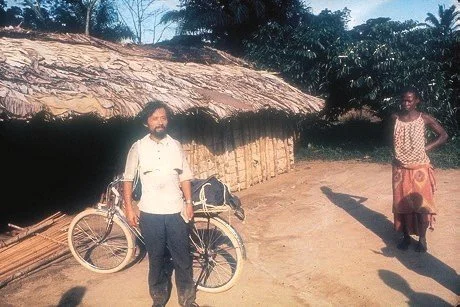
Takayoshi Kano during his 1973 cycle survey of bonobo populations in the Democratic Republic of the Congo. Sourced from “Bonobos and People at Wamba: 50 Years of Research” by Takeshi Furuichi.
Kano had initially started his journey by Peugeot 404, a journey now impossible as the wide roads have since been engulfed to mere trails after not being maintained since the 1990s. Having spent almost more time broken down than on the move, and after the engine welded to the chassis broke free for the second time he resorted to travel by bicycle, often dismounting to push through deep sand.
Upon arrival in the villages of Djolu, Kano was met with a large degree of hostility and abandoned his planned venture into the forest. He returned to the road, headed west, and established a site at Wamba. Kano later remarked, “Now that I think about it, Djolu was in the backcountry, so the inhabitants were probably a little wary of foreigners. To them, it was unthinkable that someone would come all the way from abroad just to “see” useless animals like bonobos, without killing or capturing them alive”.
Had he ventured a further 4 kilometers into the forest from the trails north of Yetee village, Kano would have been walking underneath the trees in what is now the Kokolopori Bonobo Reserve – the forest where our stories and scientific findings have been birthed.
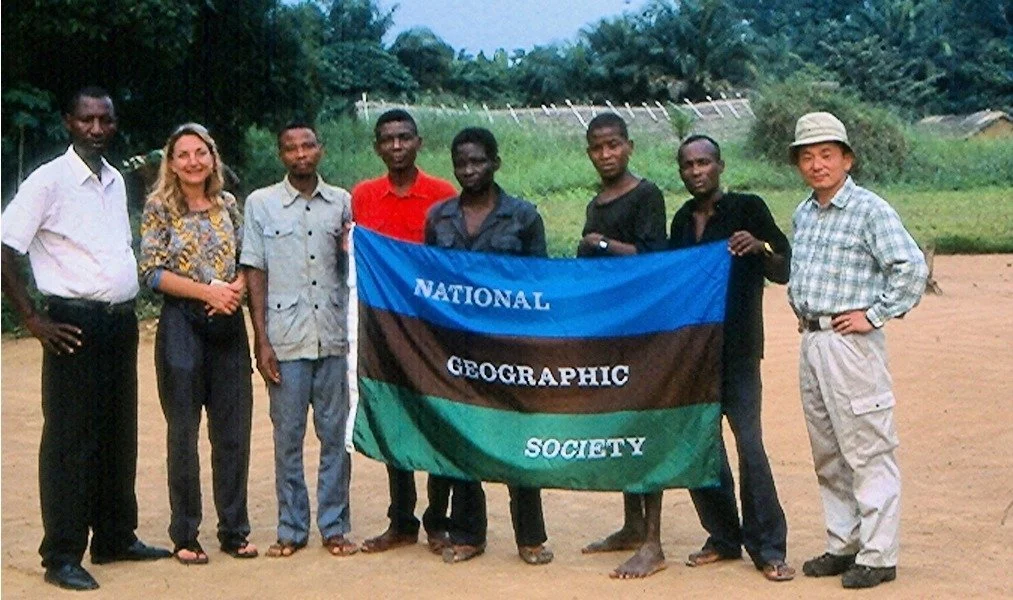
Sally Coxe visited Wamba for the first time in 1994, and again in 2002, funded by a National Geographic Explorers grant. There, she learned the local language (Lingala) and began to collect indigenous Bongando folklore about bonobos.
20 years later, in the mid-1990’s, Sally Coxe made a visit to Kano’s field site at Wamba, fueled with passion to learn about and protect bonobos. Her commitment had been inspired by working with the world-renowned captive individuals of linguistic flair, Kanzi and Panbanisha (Kanzi passed away in 2025 at the age of 44). Here she realised the best protectors of bonobos and wildlife was not the foreigner, but the indigenous communities themselves – provided they were given the right resources, opportunities and support. She went on to found the Bonobo Conservation Initiative (BCI) during the political instability of the Congo Wars.
Back in the Djolu territory, in the villages surrounding Yetee where Kano had aborted his mission, Albert Lokasola founded the conservation organisation Vie Sauvage. Around the turn of the millennium, he made a risky but ultimately auspicious decision to encourage other locals to follow and habituate the bonobos to human presence, hoping this would attract the interest of researchers. After some years the bonobos began to allow the trackers to fall into the backdrop of the forest, where fear nor interest was expressed. Sure enough, BCI forged a partnership with Vie Sauvage in 2001, the beginning of a fruitful relationship that benefited both the local communities and the conservation of Congolese wildlife.
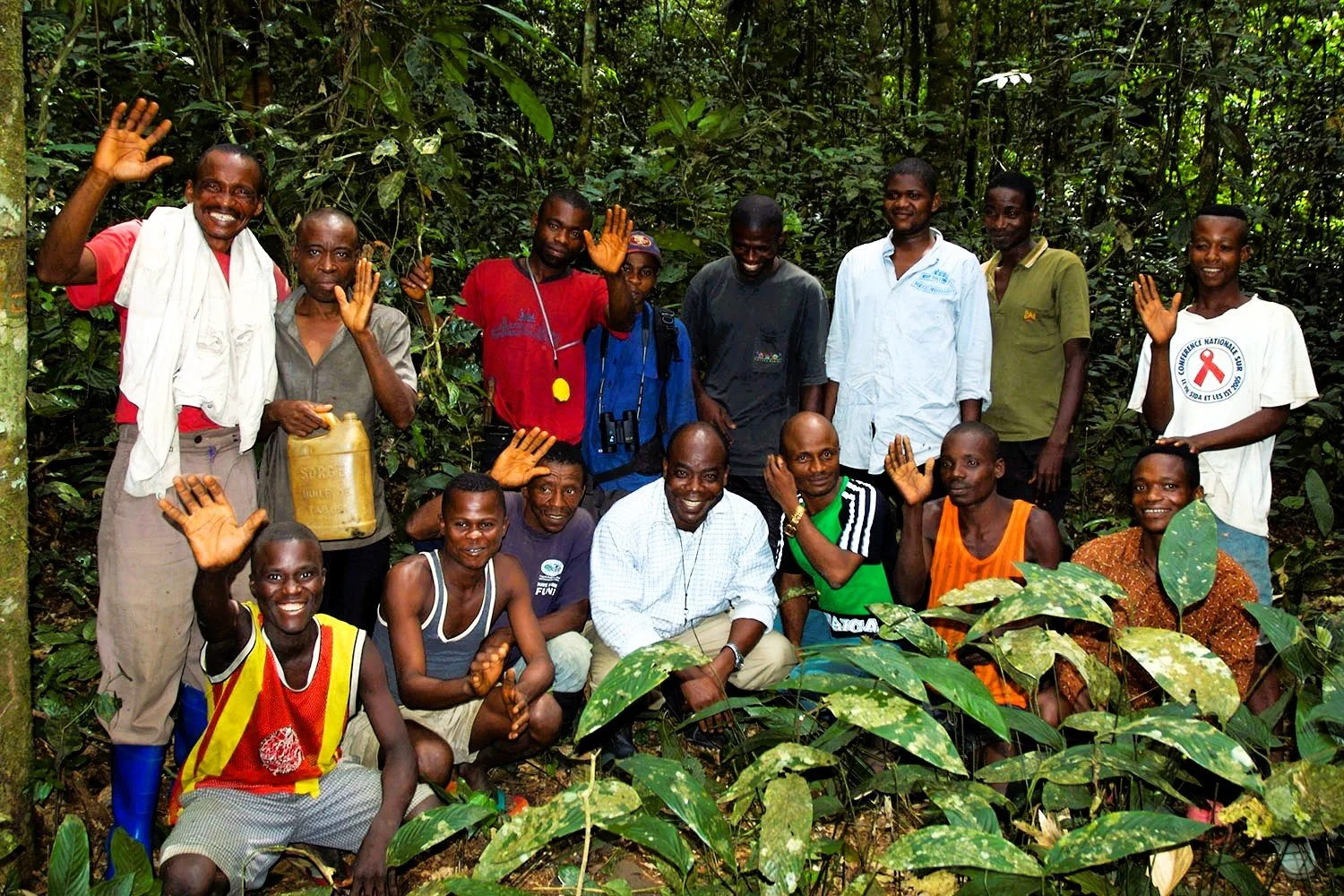
Vie Sauvage founder Albert Lokasola (center) with bonobo tracking team at Kokolopori, in 2006.
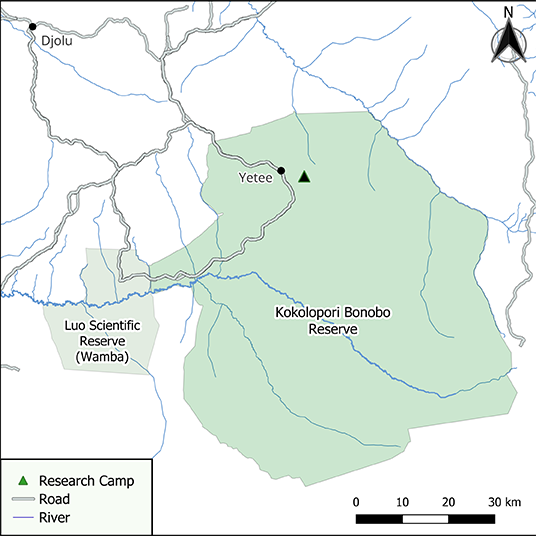
The Kokolopori Bonobo Reserve and the location of Kokolopori Bonobo Research Project
BCI began to support the local trackers and provided salaries for tracking Ekalakala in 2004, one of the first groups to be habituated on the reserve, followed by the groups Kokoalongo and then Bekako and Fekako. Its support continues to this day, providing equipment, training and long-term assistance. For the surrounding communities, this provided a new and alternative opportunity of livelihood, boosting the incentive to care for bonobos and their habitat.
A great leap in conservation was made in 2009 when the 4,875-square-kilometer Kokolopori Bonobo Reserve was formally recognised by the Congolese government through the works of BCI and Vie Sauvage. This is the first patch of the Bonobo Peace Forest, a growing network of community-led reserves created and managed by BCI and local partners. Now, this all sounds very good, but you may be wondering what does this actually mean? Or how can such a vast area be protected in one of the five poorest nations in the world? In truth, with a great deal of difficulty.
Within the reserve, killing bonobos, commercial logging, wire snares and the commercial bushmeat trade is prohibited. Again as you can imagine, enforcing these restrictions is tricky, for example wire snares are even still found in and around the study site. We cannot expect these activities to stop overnight, and efforts to monitor and map them would help us prioritize areas for investigation and future work.
As mentioned, killing and eating bonobos is taboo in the Djolu region, a custom which evolved due to local recognition (by the Bongando people) of the species’ similarity to human beings. Nonetheless, in the midst of an economic crisis, taboo is often overcome by desperation and acts of raw survival. This is where BCI’s philanthropic efforts to empower women, provide medical clinics, education, disease-resistant crops and alternatives to bushmeat gives that vital buffer during unstable times and mutually beneficial relationships to warrant reserve status in the region.
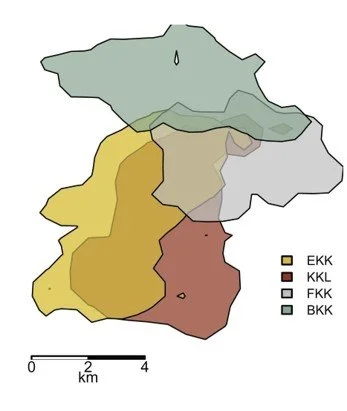
Territories of the bonobo groups at the Kokolopori Bonobo Research Project showing Ekalakala (EKK), Kokoalongo (KKL), Fekako (FKK) and Bekako (BKK)
A survey from 2012 revealed the reserve is home to over 1800 bonobos, between 5-20% of the global wild population. Shortly afterwards, BCI invited Martin Surbeck from the Max Planck Institute to initiate the Kokolopori Bonobo Research Project, where 82 individuals are tracked on the north edge of the reserve. 4 distinct groups called Ekalakala, Kokoalongo, Bekako and Fekako roam the reserve freely. As you will see, the members of each group are named according to different themes. Kokoalongo is named after musicians (not just David Bowie and the likes of the 70’s, but also rappers and pop artists like Tupac and Shakira), Ekalakala after colours, and both Bekako and Fekako after rivers. While personality has been a controversial topic in ethology, it’s hard to ignore the fact that each group has a specific set of character traits. More on that to come – we’ll dive into personality and anthropomorphism in science in a future blog post!
The roles of Sally Coxe and Albert Lokasola, BCI and Vie Sauvage, in the establishment of the reserve and in supporting the trackers and local community are central to the story of research and bonobo conservation at Kokolopori. But would the locals have decided to start tracking bonobos in the forests without Kano’s cycle trip and the establishment of Wamba? Likely not. News certainly spread from village to village about what benefits a long-term research site brings to the local economy. One thing for sure is that Kano’s your man if you're looking for a crash course in jury rig mechanics.
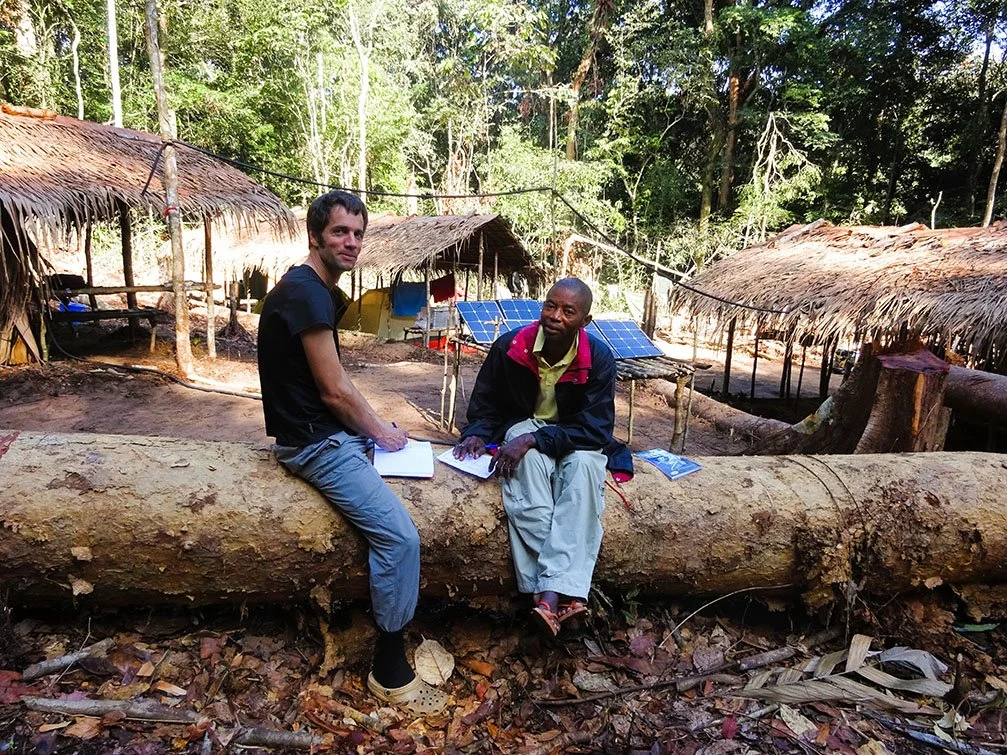
Dr. Martin Surbeck and lead tracker Leonard Nkanga in 2016, during the establishment of the Kokolopori Bonobo Research Project camp near Yetee.