The Birth of Maira & Her Path to Independence
Mississippi's newborn named Maira is born into a life on the move
Author: Phoenix Lester, edited by Kris Sabbi
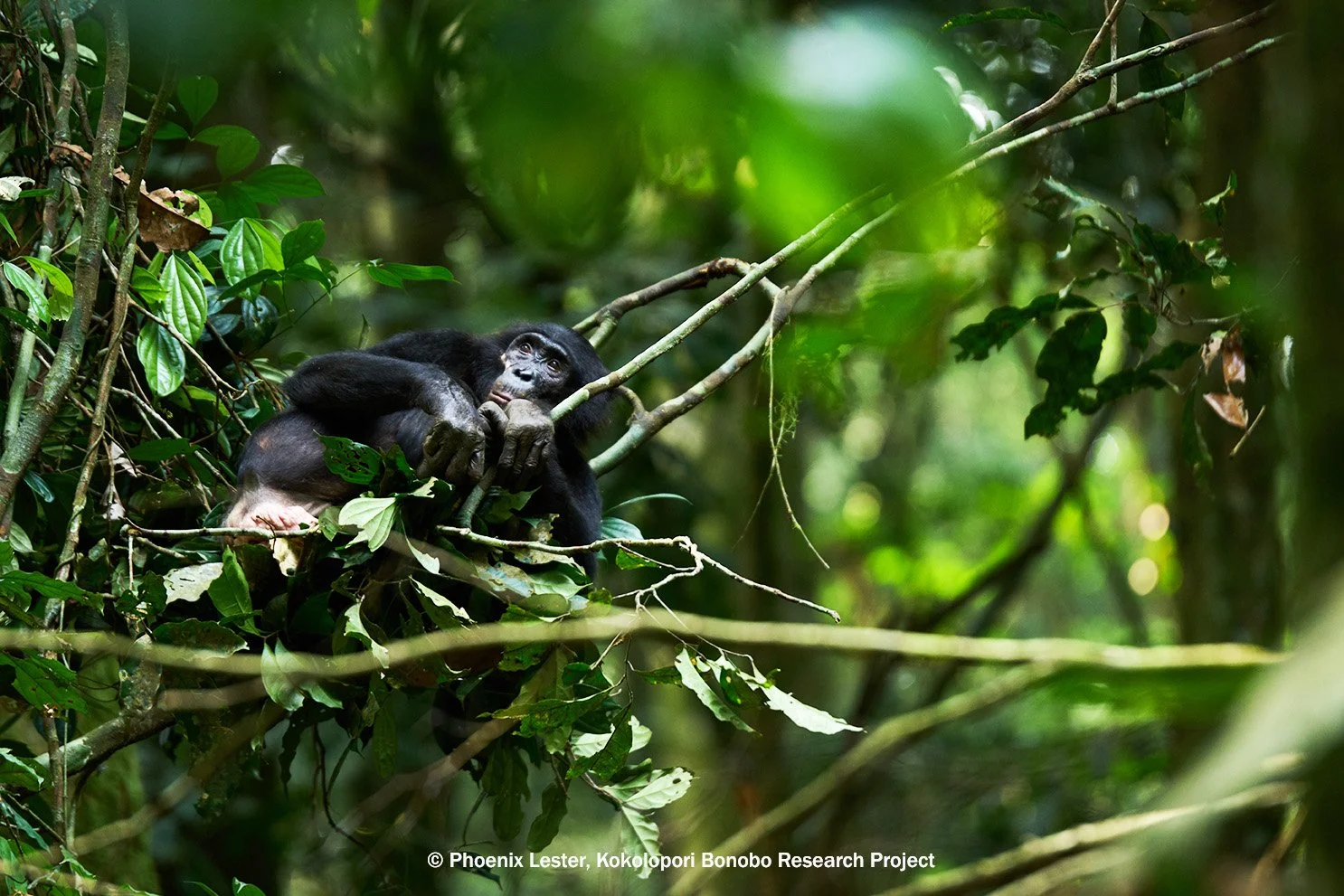
Ivoire, the alpha female of Ekalakala napping in a day nest, the folded-branch construction clearly visible.
20th March 2025
We arrived at the nest site at 5:30 AM, dark silhouettes of the bonobos nests dotted about the canopy beginning to stir as the day took its first grip on the night. The blur of two juveniles chased each other from nest to nest, whilst the adults woke through a more languid awakening.
The day before we had an exciting new addition to the community, when Mississippi, an adult female who had not been seen for four hours, returned with a newborn female (soon to be called Maira) clinging tightly to her underside. Most heavily pregnant bonobos at Kokolopori leave the group for extended periods of up to a month, so to be able to catch a glimpse of such a young wild bonobo is exceedingly rare.
The group descended from the canopy and drew straight lines between Bokoli trees, stopping off to feed lavishly on the fruits scattered on the forest floor when the cadence of the group slowed to a sleepy halt. They lounged around in shattered light, listening to the forest expand endlessly around them. It wasn't long before Nelson, an adult male began to sift through Mississippi's thick fur and pick it clean of forest debris and parasites. A gap in the foliage gave us the first good view of Maira, presenting the rare opportunity to photograph this bonobo less than 24 hours from her birth.
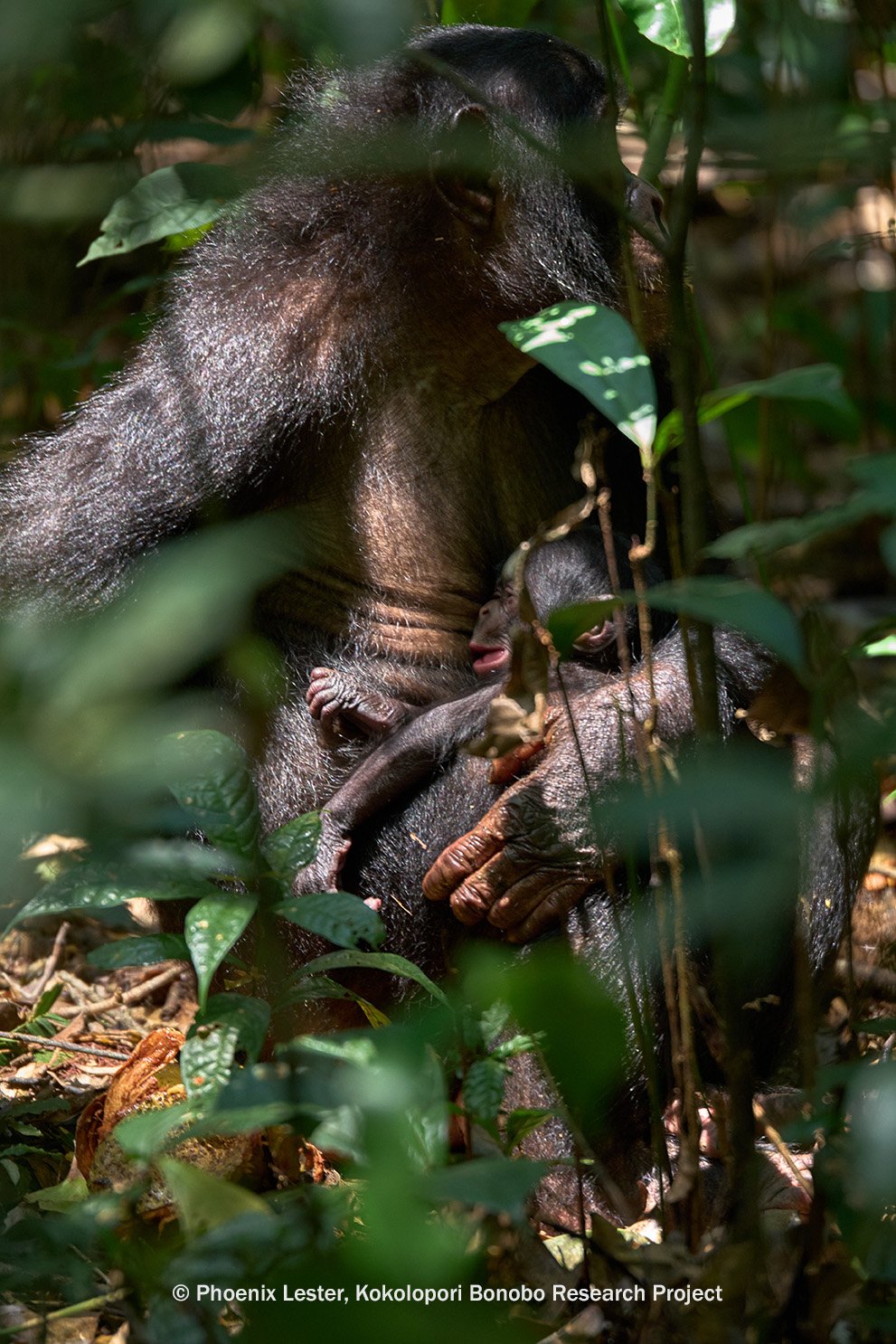
Maira, a wild bonobo from Fekako held by her mother Mississippi at under 24 hours of age. As with the rest of the Fekako community, she was named after a river by the field assistants.
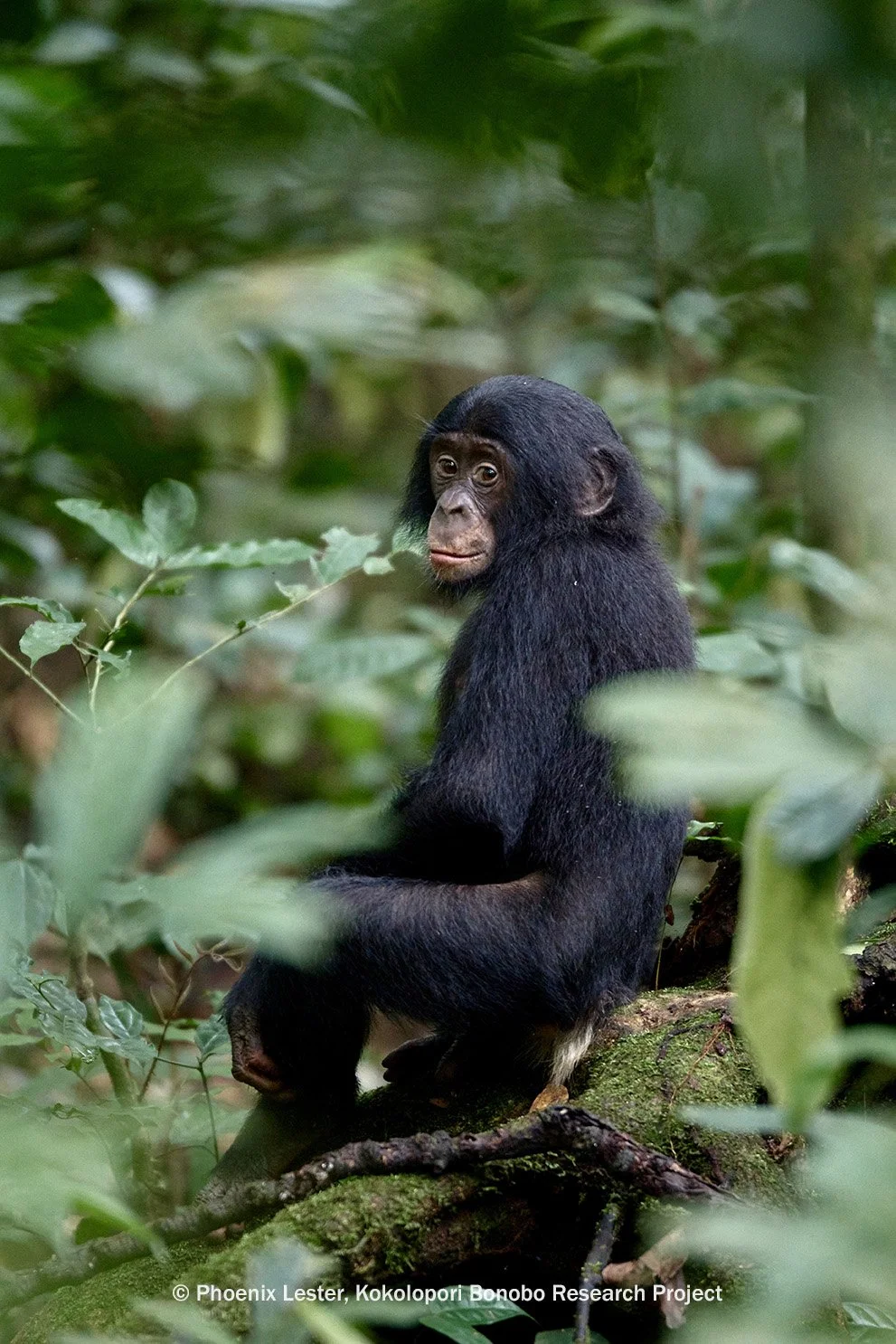
Missouri, Mississippi's eldest son at six years old. With the birth of a younger sibling Missouri will likely be carried less by his mother and travel more independently. He forms a lifelong bond with Mississippi, as she influences his reproductive success and social status (Surbeck, Mundry and Hohmann, 2011).
Maira had a thick coat of hair and moved with exaggeration and trembling fragility. Despite her frailty, she was born with the strength to grip herself onto the underside of her mother at all times - even whilst sleeping. Moments after this photo was taken she passed her meconium, the thick and sticky first feces of a newborn made from substances ingested within the uterus. It was collected by tracker Jerry Belongo, and later frozen for analysis. Samples like these allow us to determine the father, and may even serve to inform us about the health and diet of Mississippi.
From day one she had to cling onto the haven of her mother as she navigated the social dynamics of Fekako and neighboring communities. As she grows, she will learn to find her place within the group, lessons that will put her in good stead for around eight years’ time, when she decides to leave Fekako in search of another group.
Maira’s Path to Independence
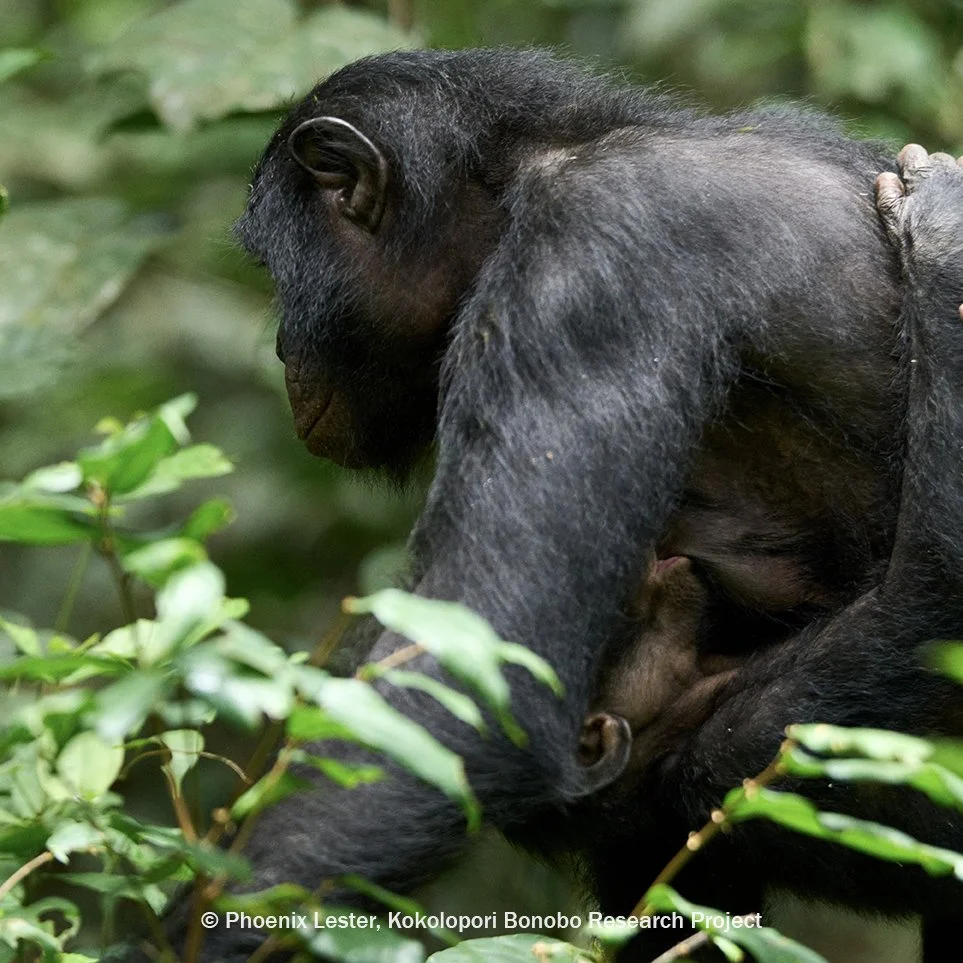
Kokoalongo members Tyler and Tango. Tango nurses whilst being carried ventrally (on the belly), an infant female of three years old. Primiparous parents (mothers with their first offspring) tend to be more protective with their offspring than experienced parents, leading to longer ventral riding and slower rates of independence (Vlaeyen et al., 2025)
While we have hints of the trajectory her life will take, most of what we know about bonobo development is limited to shorter term studies on small numbers of individuals. What follows is the story of Maira, pulling from anecdotes of other young bonobos and research to thread a narrative of what her future years may hold.
Now one year old, Maira's world has extended to an arm's reach from Mississippi where she explores new sensations of taste, touch and relationship. She climbs on her mother, hangs off one arm and spins, unleashing raucous giggles as Mississippi reaches out to tickle and bite her belly. They travel with the group visiting fruit trees through the seasons, sustained by her mother’s milk; her curiosity brings her to taste the foods she will one day depend upon for survival.
Around three years old she takes a fancy to riding on the back of Mississippi in ‘jockey style’, sometimes reaching out to grab plants and feel the foliage pass through her fingers. Her mother settles down on a fallen log to groom, freeing her up to wrestle and play with the other youngsters she has now grown familiar with. Her mother shunts her away as she returns to nurse, gradually urging her to develop her foraging skills. As the evening light sinks into dusk, the group will build their nests in the canopy, snapping branches inward to form a platform. Maira makes her own close beside her mothers, but abandons it during the night, moving in to sleep together just as she has always done.
Towards six years old Maira travels independently, is fully weaned and might even have a younger sibling. For now, she will move with Fekako under the throb of the equatorial sun, frigid nights, and some of the world's most fierce and frequent thunderstorms. Soon she will flow from group to group and settle amongst new faces, and there, she may rear children of her own.
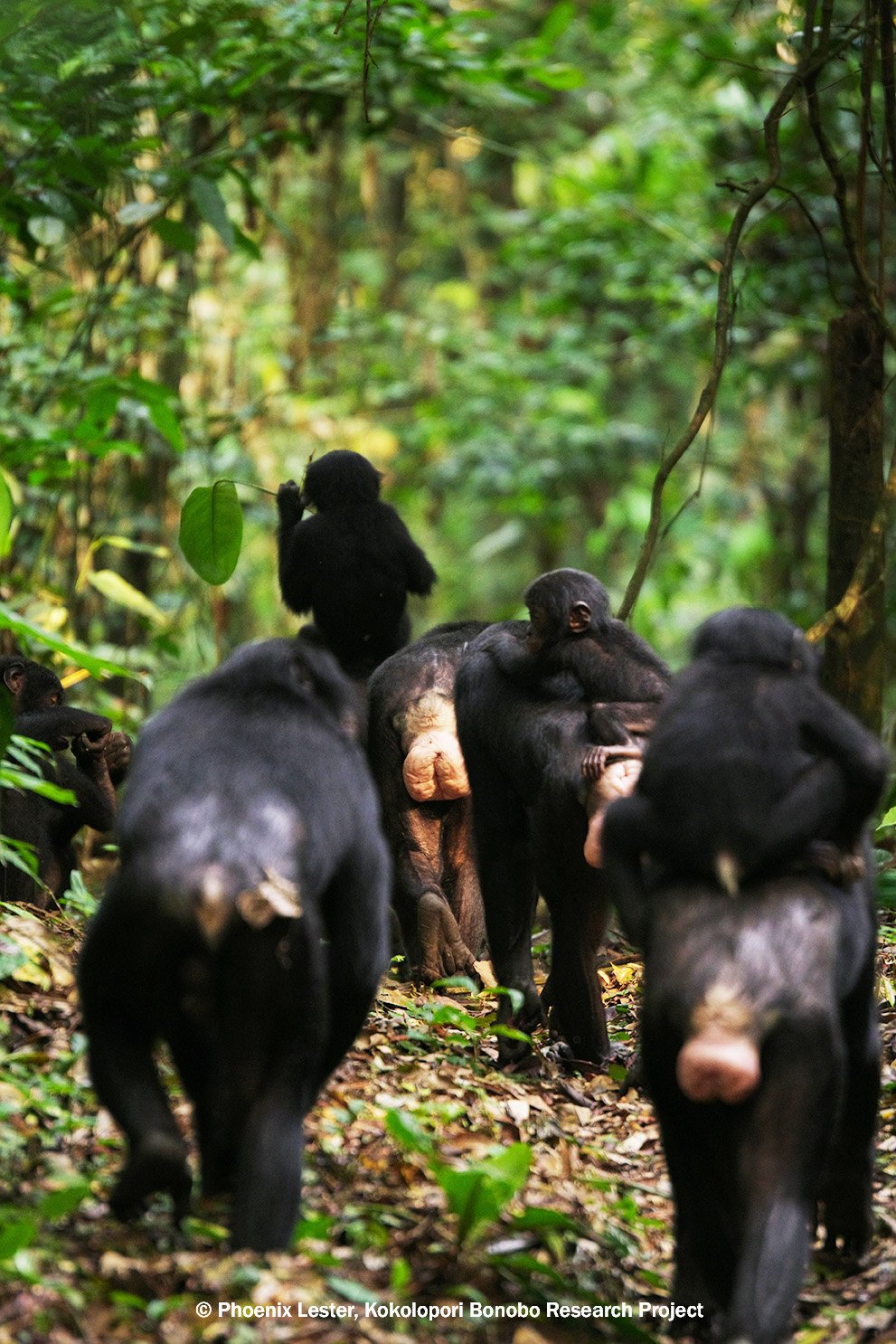
Kokoalongo members travelling. Prince, Etta and Tango being carried dorsally (From left to right). Prince carries a Kokolo leaf (Thaumatococcus sp.) picked on the way.
Researchers have yet to follow a cohort of young bonobos through the entirety of their early lives from birth to independence. We can see when they stop nursing, but how do they learn the ins and outs of their complex diets? We know when they leave their natal groups and when they show up in new ones, but how do they learn the social rules of navigating bonobo society? What we can already sense is that there is substantial variation in their pathways toward adulthood. Through the continuation of long-term research and conservation initiatives like BCI, we will be able to answer some of these simple, yet burning questions that reveal a spotlight onto our own evolutionary history.
Maira’s future, however, is uncertain. The threats she faces are vast, from habitat loss to the bushmeat trade and civil unrest. Fortunately through the work of BCI (Bonobo Conservation Initiative), anyone around the globe is able to have a positive impact on Maira and the next generation of our close evolutionary relatives. BCI’s work supporting local communities not only gives hope to bonobos, but also other fauna and flora of the Congo Rainforest - the second largest rainforest in the world.
Human Evolution of Bipedalism and the Newborn
Development of bipedalism and large brains in our evolutionary history, respectively evolving around 7 and 2 million years ago posed huge consequences for childbirth. Bipedal gait drove our hips narrower and constricted the birth canal, conflicting the evolution of the larger brain. Evolution's solution? Give birth to younger, more underdeveloped, dependent offspring. This is known as the ‘obstetrical dilemma’ (Fremondiere., et al 2022). This contrasts to Maira, who represents the non-human primates in that she was born relatively developed.
Scientists have suggested that metabolism could be at play for explaining the underdeveloped newborn trait in humans whereby the human body cannot sustain the energetic demands of a developing fetus beyond 40 weeks (Dunsworth et al., 2012). This human trait, whether obstetric, metabolic, or both, has been associated with greater behavioural flexibility and adaptability to our surroundings (Gomez-Robles., et al 2024).
REFERENCES
Surbeck, M., Mundry, R. and Hohmann, G. (2010). Mothers matter! ‘Maternal support, dominance status and mating success in male bonobos (Pan paniscus)’, Proceedings of the Royal Society B: Biological Sciences, 278(1705), pp.590–598. doi:https://doi.org/10.1098/rspb.2010.1572.
Vlaeyen, J.M.R., van Boekholt, B., Wegdell, F., Katumba, R., Berghänel, A., Surbeck, M. and Pika, S. (2025). ‘Great Ape Childhoods: Social and Spatial Pathways to Independence in Bonobo and Chimpanzee Infants’, Developmental Science, 29(1). doi: https://doi.org/10.1111/desc.70102.
Frémondière, P., Thollon, L., Marchal, F., Fornai, C., Webb, N.M. and Haeusler, M. (2022). ‘Dynamic finite-element simulations reveal early origin of complex human birth pattern’, Communications Biology, 5(1). doi: https://doi.org/10.1038/s42003-022-03321-z.
Dunsworth, H.M., Warrener, A.G., Deacon, T., Ellison, P.T. and Pontzer, H. (2012). ‘Metabolic hypothesis for human altriciality’, Proceedings of the National Academy of Sciences, 109(38), pp.15212–15216. doi: https://doi.org/10.1073/pnas.1205282109.
Gómez-Robles, A., Nicolaou, C., Smaers, J.B. and Sherwood, C.C. (2023). ‘The evolution of human altriciality and brain development in comparative context’, Nature Ecology & Evolution, [online] 8(1), pp.1–14. doi: https://doi.org/10.1038/s41559-023-02253-z.