A group of wild bonobos is often on the lookout for meat - but catching it can be a challenge.
Author: Phoenix Lester
FROM September 19, 2025
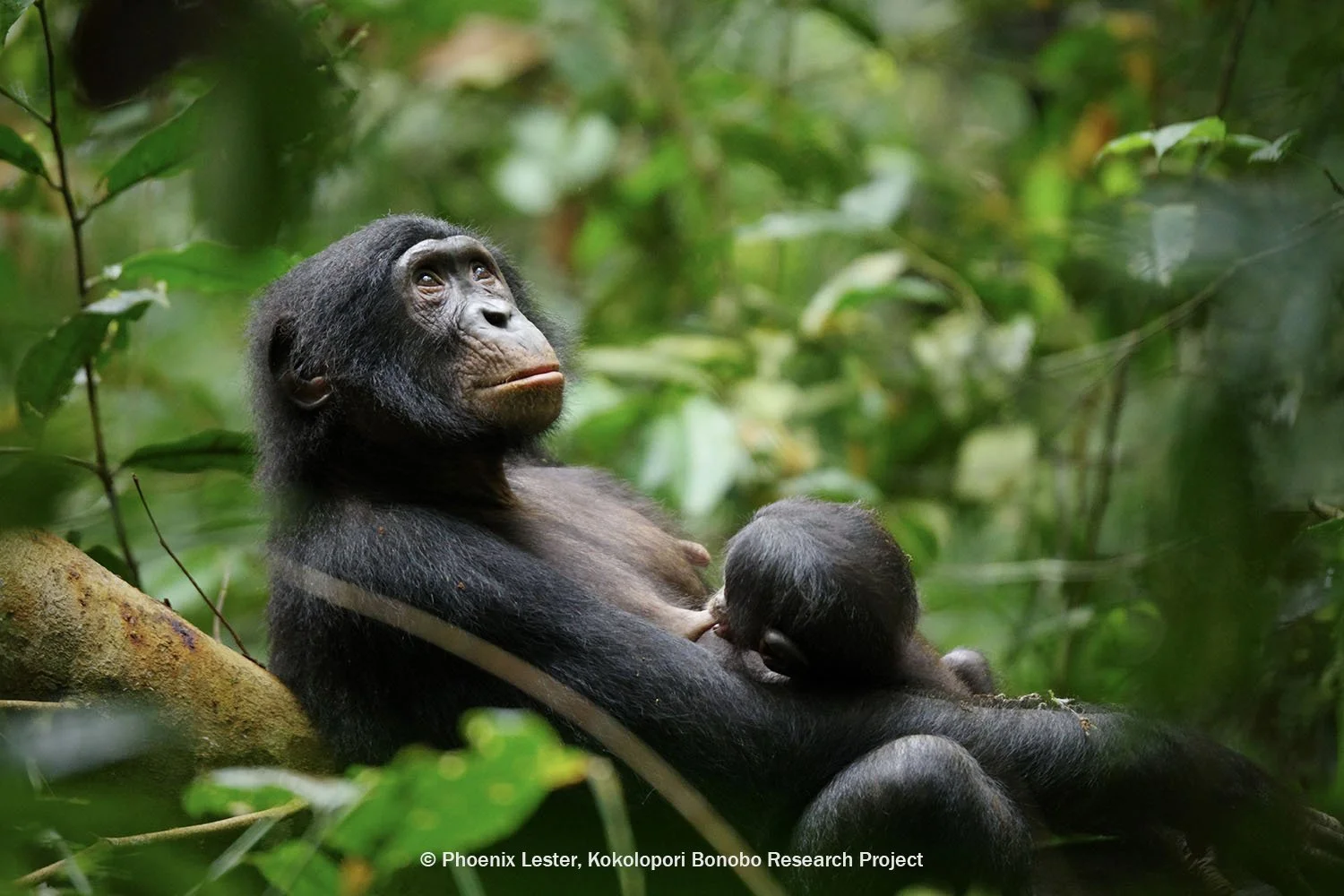
Eben, a female bonobo, watches her group members as they examine the hole in the tree whilst her 11-month-old son, Etoile, nurses.
“They are searching for Bolingo” said the experienced tracker Bruno Batoli, as he kept a keen eye on the movements of his focal bonobo whilst cutting his way through the forest. Bolingo (Anonidium mannii) fruits often grow to the size of a football and are found ripening on the forest floor. Their cracked, sooty exterior created an anomalous burnt texture amongst the damp leaf litter. Odours of sweet, slightly fermented mango drifted low and thick as the bonobos heaved them open and used their teeth to scrape the bright orange pulp from the large seeds.
We were following Ekalakala, one of the four habituated groups at the Kokolopori Bonobo Reserve in the Democratic Republic of the Congo (DRC). A young male, named Emeraude, raised his head from his Bolingo as a hole in a nearby tree trunk drew his attention. Abandoning the fruit, he scampered up the tree to peer into the dark hollow and let out a discreet peep. Down below on the forest floor heads immediately turned upwards, silky light reflecting off of their polished faces, the fruits left half eaten as flies and beetles began to settle. From the way the group suddenly left behind such a highly prized meal, we could tell we were on the precipice of something exceptional in bonobo culture: a hunt.
Three adult females, Azur, Olive and Eben, peered over Emeraude's shoulder as he eagerly reached inside the hollow trunk to the crook of his armpit, his finger tips raking at the spongy wood in hope of brushing against soft fur. Ten minutes of reaching, peering and turn-taking followed, before more desperate attempts began as some individuals violently shook the trunk from side to side. Gradually, their interest faded. The group settled, perching and resting, as if conceding defeat.
In the security of silence the flash of a shadow threw itself out and away from the trunk, transforming into a square shadow that glided eloquently through the forest. It was a lokiyo (Anomalurus derbianus), a species of flying squirrel weaving its way down towards the Lonua creek as it made a swift escape into the safety of flight.
Emeraude and the three females slid down the tree, tearing moss and dust particles airborne, joining his group to gallop through the undergrowth as their eyes darted skyward into the canopy. We struggled to keep up as we battled our way through the forest, guided merely by their shrill vocalisations. “We will never be as fast as them,” Bruno said, admiration unmistakable behind his facemask. “They are experts of this habitat.”
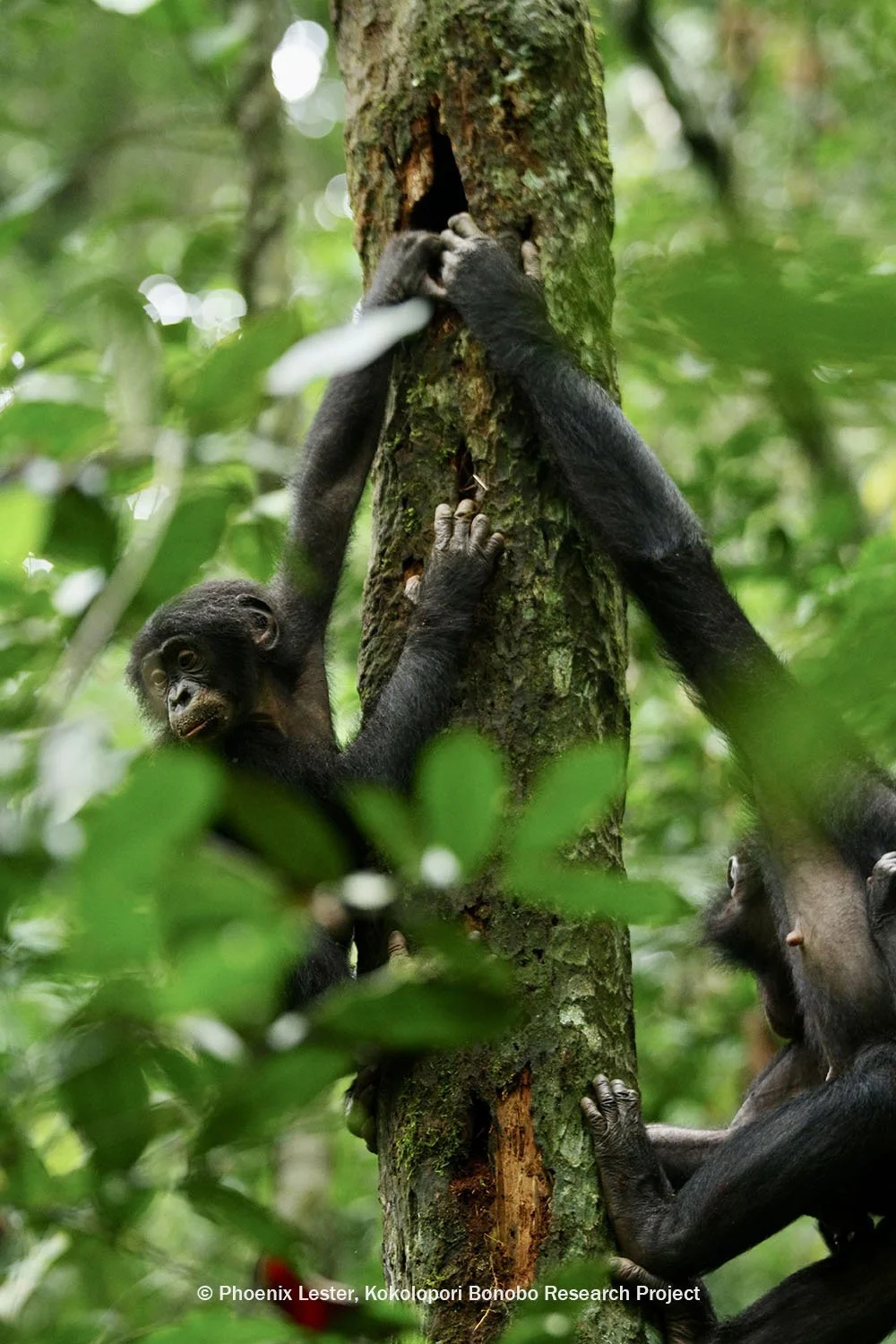
Emeruade and an adult female hang from the opening of the hollow where the prey is hiding.
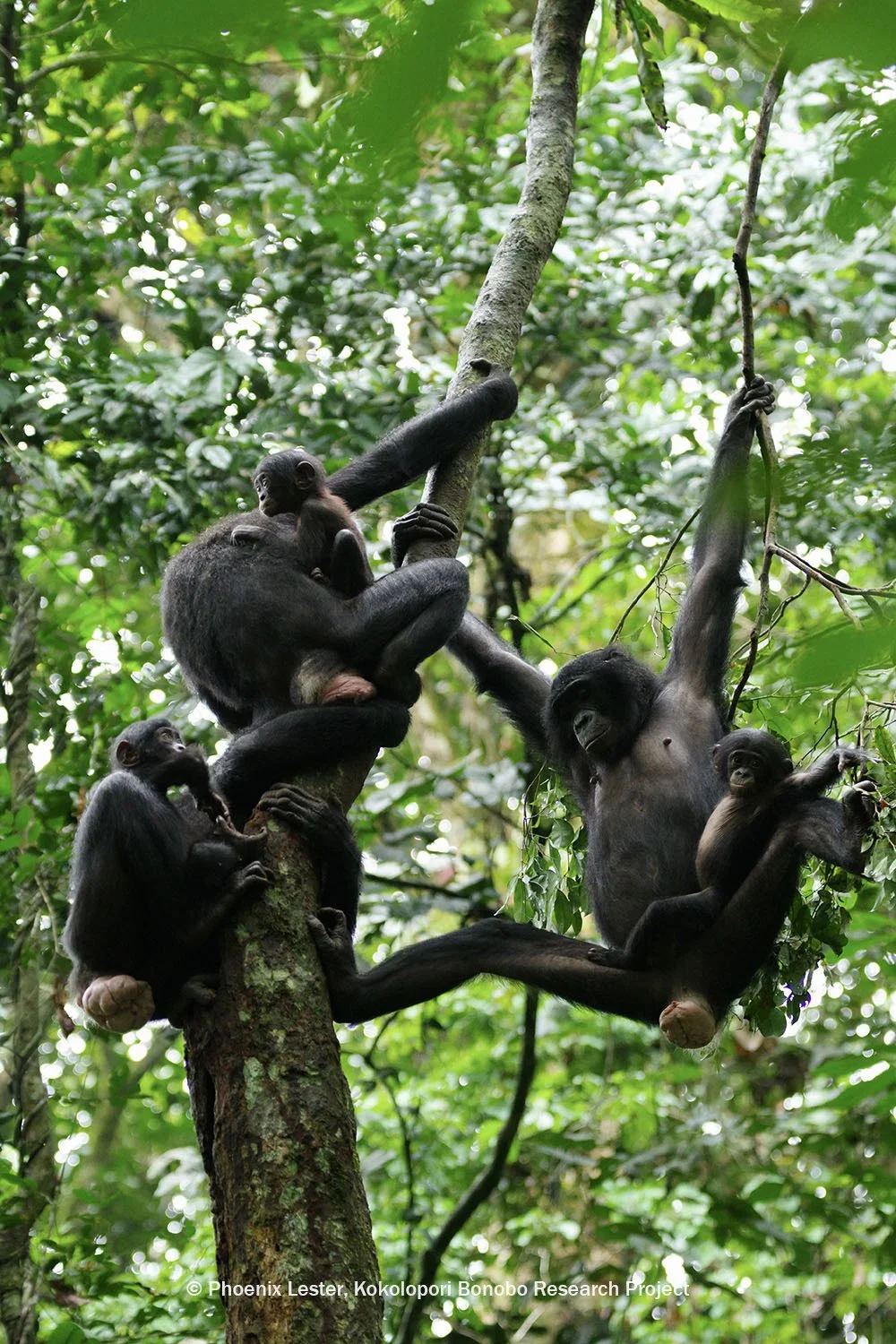
Olive solicits a genito-genital rub with Azur or Eben as they struggle to capture the prey.
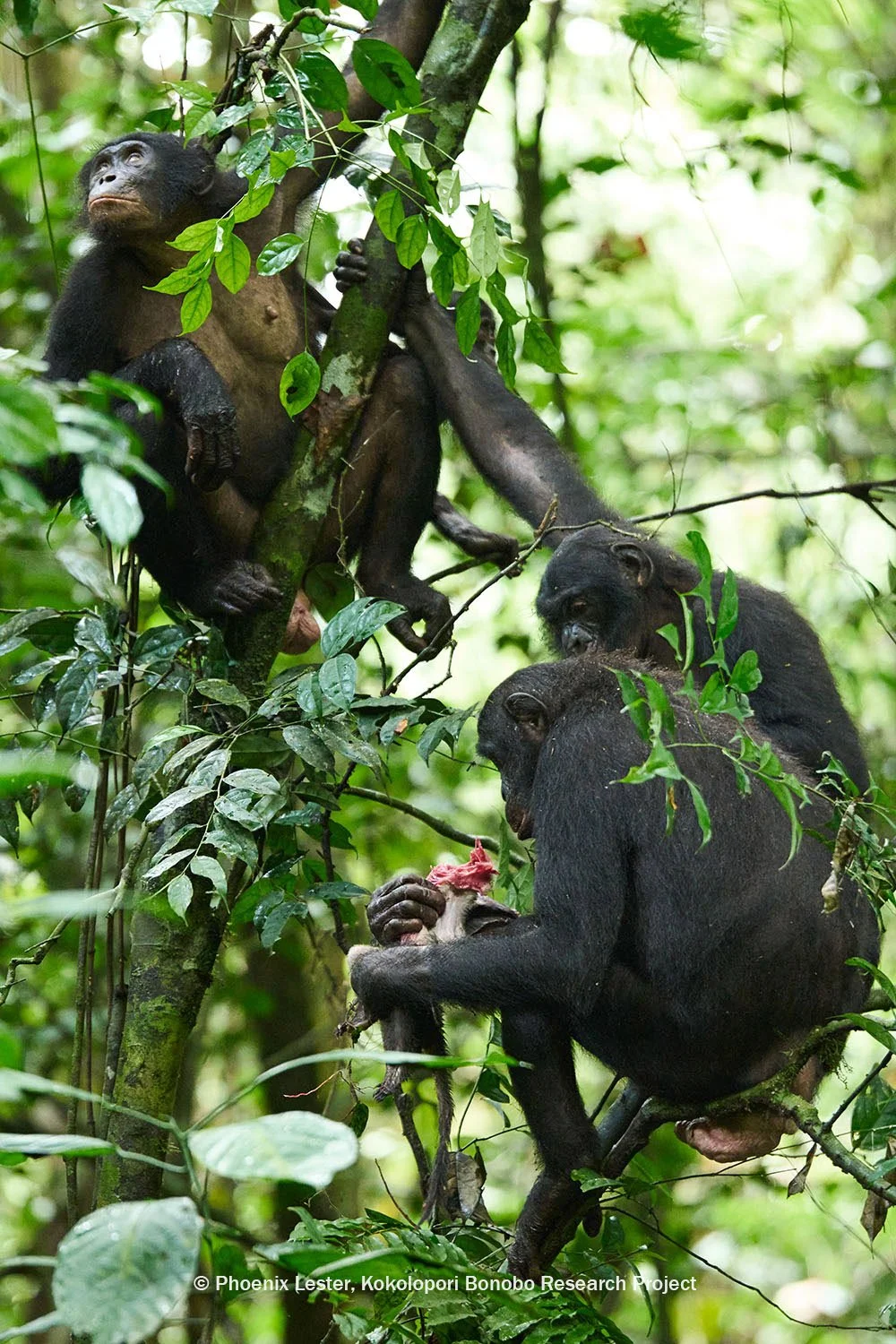
Ivoire, the alpha of the Ekalakala bonobo group eats a freshly caught lokiyo as Saphir and Bleue express their interest in the catch.
Vocalisations merged into a cacophony and we at last began to gain ground on the group. As the scene came into view, a female bonobo clutched and teared at the limp and warm carcass of the lokiyo, its red flesh glowing vividly against the emerald hues of the forest. Although we could not be sure who made the kill, this time the prey was in the hands of the alpha and estimated oldest member of Ekalakala, Ivoire. She enjoyed the catch to herself as group members including Emeraude sat and watched, allowing only some of the boldest infants to touch it and lick the blood from their delicate finger tips. As she opened her mouth for another bite we noticed only a few sparse and tarred teeth remained, reflecting her great age as a forest sage.
This is an account of a Lokiyo hunt, but it isn't the only prey that falls to the hands of bonobos, they are also known to hunt species of rodents, antelopes and monkeys. Despite this diversity, recent research has shown that the flying squirrel might be a culinary speciality to Ekalakala, with other groups in the reserve such as Kokoalongo focusing on species of forest antelopes (Samuni, Wegdell and Surbeck, 2020). These puzzling differences in diet may even be cultural, and is an exciting insight into our ancestral history.
Hunting strategies in bonobos are largely unknown and through the invaluable work to monitor this species in the wild, we are not only able to reveal their wonders, but most importantly work with the local community for the establishment and conservation of wild spaces.
Hunting in bonobos and chimpanzees
Historically, the degree of hunting behaviour was commonly thought of as one of the large differences between bonobos and chimpanzees, with the latter exhibiting much higher levels of hunting (Boesch, Hohmann and Marchant, 2002). Although differences clearly do exist, the understanding that hunting in bonobos is absent or rare is being revised as research expands to include more communities with natural levels of prey throughout the DRC.
Meat eating activity after a successful lokiyo hunt in Kokoalongo, a neighbouring bonobo community to Ekalakala in the Kokolopori Bonobo Reserve. Madonna navigates some audacious group members as she attempts to feed in peace. Video © Phoenix Lester, Kokolopori Bonobo Research Project
REFERENCES
Samuni, L., Wegdell, F. and Surbeck, M. (2020) 'Behavioural diversity of bonobo prey preference as a potential cultural trait', eLife, 9.
Boesch, C., Hohmann, G. and Marchant, L.F. (2002) ‘Behavioural diversity in chimpanzees and bonobos’, Cambridge University Press.