
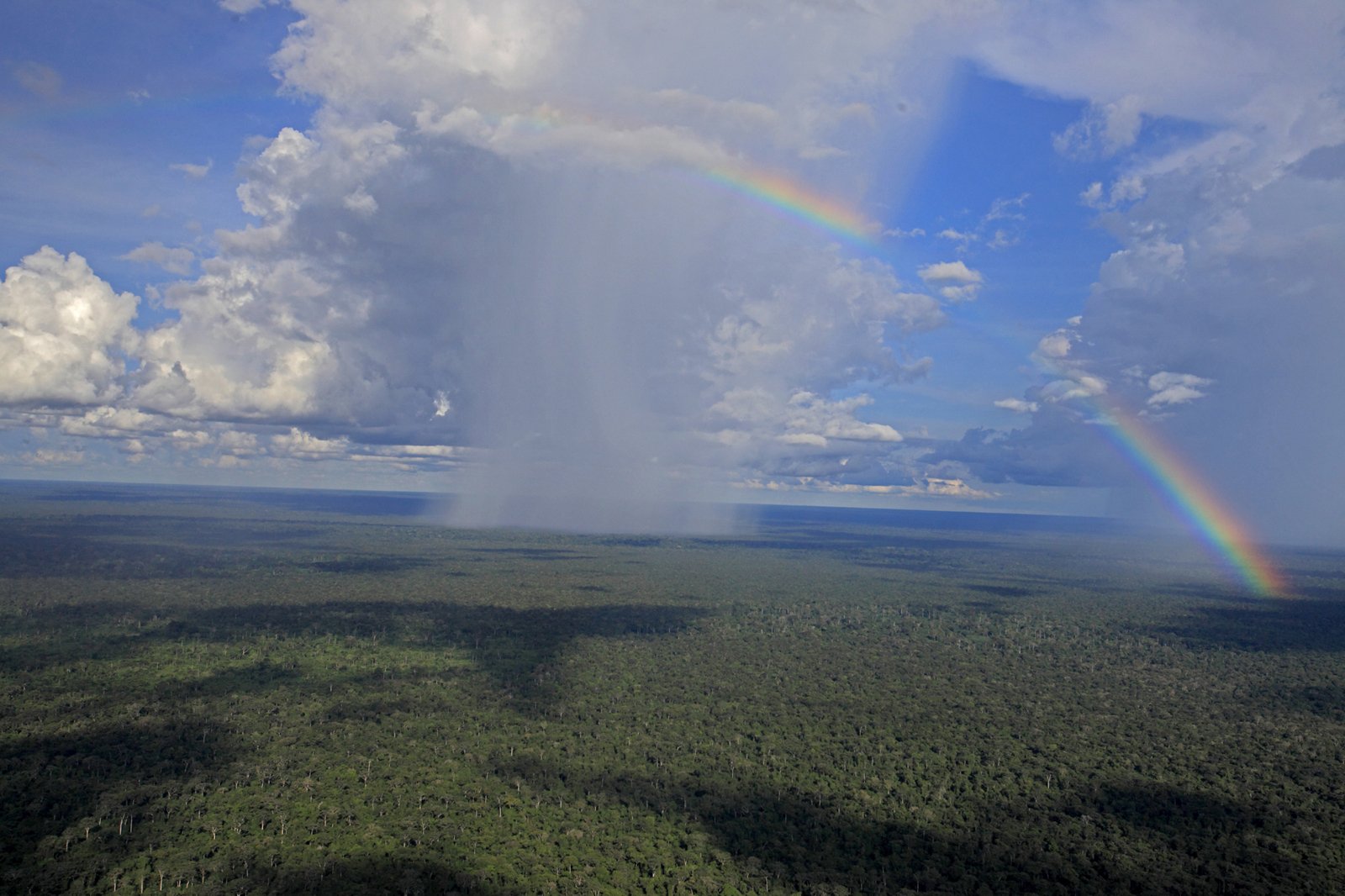
Preserving rainforest
Photo © Christian Ziegler, National Geographic
The Congo rainforest—the only home of the bonobos—is one of Earth's most precious treasures. The second largest rainforest on the planet, it plays a crucial role in mitigating climate change, preserving biodiversity, and sustaining all life.
To protect this vital land, BCI and partners created the Bonobo Peace Forest: a network of community-based reserves, supported by sustainable development. The Bonobo Peace Forest is an integrated approach to conservation that addresses the underlying ecological and human forces that shape the destiny of the Congo rainforest.

7 sites
two officially protected areas, five more in development
1,950
million acres of rainforest protected, two million more in progress
9,000,000
trillion tons of CO₂ sequestered
Though all of the Bonobo Peace Forest sites have common goals, each one has a unique and fascinating story.
Kokolopori Bonobo Reserve

Photo © Kokolopori Bonobo Research Project -
The Kokolopori Bonobo Reserve is the pilot and model for the Bonobo Peace Forest. Harboring one of the largest known bonobo populations, Kokolopori is an exceptionally important site for conservation and research. It is one of the few sites where bonobos are habituated to the presence of humans. Four bonobo groups can be viewed on a daily basis—a boon for both research and, eventually, ecotourism.
-
The indigenous Bongando people at Kokolopori respect ancestral traditions to protect bonobos. The Bongando are working with BCI and managing partner Vie Sauvage to protect their forest while at the same time improving their quality of life. Together, we have initiated a number of promising livelihood programs, including sustainable agriculture, micro-credit and conservation enterprise programs, aid for the local schools, and a health clinic. Kokolopori has inspired nearby communities, on their own initiative, to create their own reserves based on the same model—Likongo, Lingomo, Nkokolombo, and Forêt Riche.
-
Officially established in 2009, the Kokolopori Bonobo Reserve is the result of the collaborative efforts of BCI, Vie Sauvage, Kokolopori residents, the DRC government, and other partner organizations. The development of the reserve has been driven by local interests and efforts, under the leadership of Albert Lotana Lokasola, founder of Vie Sauvage. Today, the reserve encompasses over 4,850 square kilometers (1,870 square miles) of rainforest.
Since its inception, the Kokolopori Bonobo Reserve leadership has developed conservation and community initiatives to benefit all the inhabitants of the forest, people and wildlife alike. In addition to bonobos, the Kokolopori forest harbors many other species, including a wide variety of primates. The first ever study of the rare Salongo monkey (Cercopithecus dryas) was initiated at Kokolopori where it is protected by the local population.
-
Keep the heart of the Peace Forest beating strong! Support the Kokolopori Bonobo Reserve today and make a difference for generations to come.
Click here to make a donation.
Sankuru Nature Reserve

Photo © Bonobo Conservation Initiative -
At 30,570 square kilometers (11,800 square miles), the Sankuru Nature Reserve is the world’s largest continuous protected area for great apes. This important site began at the grassroots level with local communities and is the first large-scale reserve in Congo to be co-managed by the indigenous people. In addition to protecting great apes, this reserve is also a vital part of our environmental initiatives: REDD+, watershed protection, and species conservation.
-
The protection of the Sankuru Nature Reserve is a major achievement in the fight against global warming. Nearly 20% of annual greenhouse gas emissions come from deforestation and other related habitat destruction. Keeping this rich tropical forest intact will make an important contribution to global efforts to reduce emissions while simultaneously conserving biodiversity.
Sankuru is the recipient of the first REDD+ (Reduced Emissions from Deforestation and Degradation) contract in the DRC, indicating its vital role in pioneering a new paradigm for community-led conservation. In addition to combating climate change, the REDD+ strategy also protects biodiversity and helps to ensure the livelihoods and welfare of the local people.
-
The diversity of wildlife in Sankuru is staggering. In addition to the bonobo, the Sankuru Reserve contains the okapi (Okapia johnstoni), an exotic short necked forest giraffe also native to the DRC, but not previously found outside of their known range far to the northeast. In 2006, survey teams from the Congo’s Centre de Recherche en Écologie et Foresterie (CREF) sponsored by BCI made this exciting discovery.
Sankuru also contains elephants, which have been hunted out in many other areas of the Congo forest, plus at least 10 other species of primates, including the rare owl faced monkey and blue monkey.
-
Sankuru’s most important supporters are generous donors like you. Be a part of the progress in Sankuru Nature Reserve–make a donation today!
By working together, we can make sure that Sankuru Nature Reserve maintains abundant forests, diverse wildlife, and thriving communities.
Lilungu

Photo © Bonobo Conservation Initiative -
Nestled on the banks of the Tshuapa River, Lilungu is a special haven for bonobos. The Bakela people maintain traditional beliefs honoring bonobos and are actively working with BCI to establish official protection of their forest.
With the Kokolopori Bonobo Reserve to the north and the Sankuru Nature Reserve to the south, Lilungu links a critical wildlife corridor in a key area of bonobo habitat. BCI and Congolese partner Centre de Recherche en Écologie et Foresterie (CREF) have been working together with the local community at Lilungu since 2005, conducting surveys, monitoring the bonobos, and establishing cooperative conservation and community development programs. Currently, three groups of bonobos are being monitored by local tracking teams, supported by BCI.
-
Our site in Lilungu is a great example of Information Exchange (IE) in action. The local Bakela community has longstanding taboos against hunting bonobos, even in the most trying times. When asked why they don’t hunt bonobos, they explain that bonobos are related to their ancestors. They feel a kinship with the “people of the forest.”
However, not everyone in the broader region shares this belief; traditional practices have been diluted by the war, immigration of displaced people, and the lure of the commercial bushmeat trade, which threatens all wildlife.
BCI surveys show that, in general, bonobo populations are lower where traditional taboos are absent. Information about local beliefs helps BCI and its collaborators identify the most effective way to approach potential community partners.
-
We often worry about humans encroaching on bonobo territory, but every now and then bonobos return the favor. After bonobos pilfered their cooking pots on two occasions, the women of the Merci Bonobo cooperative actually planted crops for the bonobos! These crops serve as a buffer zone, which provides a food source for bonobos, protects crops cultivated by villagers and generally diminishes human-bonobo conflict.
-
Because Lilungu residents recognize the importance of bonobo conservation, they have signed community accords to officially protect their forest as part of the Bonobo Peace Forest network. None of the progress in Lilungu would be possible without the full participation and leadership of local communities—and they need your support.
Donate today to help us protect this vital haven for bonobos!
LiLiKo (Lingomo, Likongo, and Nkokolombo)

Photo © Bonobo Conservation Initiative


-
Located in the heart of the growing Bonobo Peace Forest, the adjoining sites at Lingomo, Likongo, and Nkokolombo (LiLiKo) are shining examples of community-led conservation.
Inspired by the example of nearby Kokolopori Bonobo Reserve, local leaders initiated their own programs for conservation and have signed accords to create community-based reserves in this 2,800 square kilometer (1,000 square mile) region. These communities are now conducting participatory mapping, an important step in gaining official protection for their forests.
-
Help us protect these key sites and support the work of our Congolese partner organizations: Conservation of the Resources of Lingomo, Association for Conservation of Bonobos in the Source of Lomako, and Début Likongo for Conservation and Development.
Other areas
Photo © Alexia Lewnes
-
BCI has conducted surveys and confirmed bonobo presence in a number of additional sites. They have formed partnerships and signed accords at Fôret Riche, Mompono, Monieka/Bokote, Lonua, Samba, and Lac Tumba, communities who have committed to join the Bonobo Peace Forest network.
As the Bonobo Peace Forest grows, we hope to expand conservation efforts in these areas and more.
-
With your support, BCI can expand conservation activities in these areas and continue to grow the Bonobo Peace Forest. Consider donating today!
Sustaining sites with REDD+
REDD+ stands for Reducing Emissions from Deforestation and forest Degradation.
This United Nations-backed framework provides a mechanism for keeping forests intact and incentivizing forest-rich nations to engage in sustainable conservation activities. Countries—and most notably local communities—are compensated for the global environmental services performed by their intact rainforest. It’s a solution that provides great benefits for the planet and for the communities who participate. At BCI, we have always championed local leadership and community-centered conservation.
The REDD+ framework dovetails perfectly with our approach. Now that the carbon market has reached the point of viability, work is well underway. BCI is actively developing two REDD+ projects to support the Sankuru and Kokolopori nature reserves. One critical step of the process is the FPIC (Free, Prior and Informed Consent), in which communities determine their participation in the REDD+ project. To date, approximately 400 villages in the reserves have signed on to participate in REDD+. Carbon financing is a promising pathway to sustainable funding in the Bonobo Peace Forest. Currently, our first two projects are in the process of being validated under the Verified Carbon Standard (VCS).